Plastic Random Packing Shapes
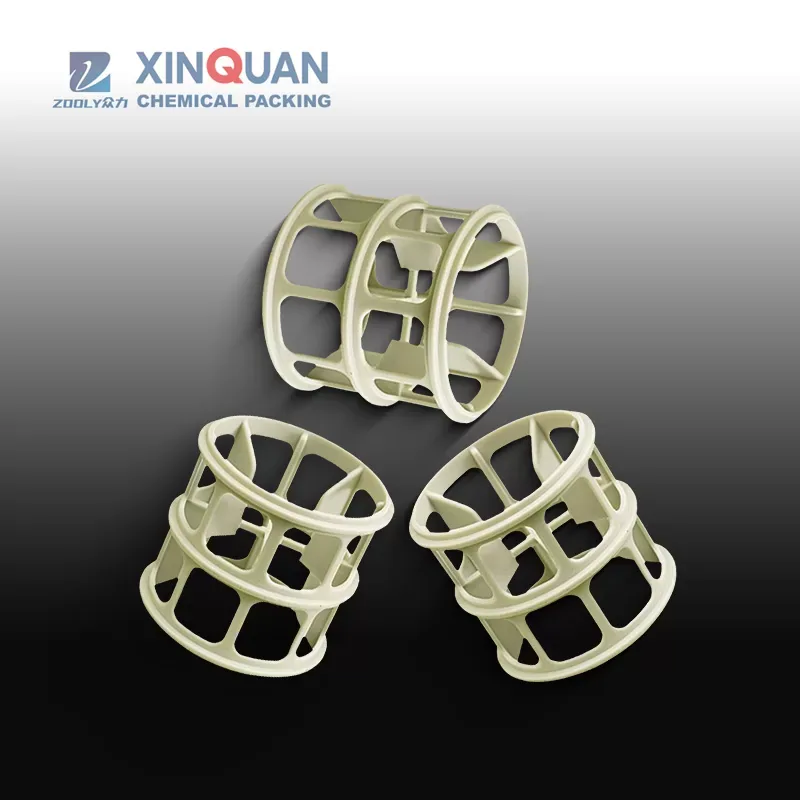
Plastic random packing covers the widest range of shapes in the catalogue, and the reason is economic: a shape can be moulded cheaply, so suppliers have spent decades inventing geometries that shift the balance between surface area, pressure drop and fouling resistance by a few percent each time. Understanding which lever each shape pulls is more useful than memorising names.
Specifications
| Parameter | Value |
|---|
| Hiflow type | Open lattice ring; low pressure drop for high gas flow scrubbing duty |
| Lanpack type | Cylindrical lattice with high voidage; used in absorption and cooling towers |
| Q-Pack type | Ring with internal structure aimed at efficiency at moderate pressure drop |
| Snowflake type | Multi-lobed open shape; large surface with low bulk density for scrubbers |
| Beta and pentagon types | Ring variants with internal partitions for higher efficiency in a shallow bed |
| Conjugated and flat rings | Simple, cheap shapes for coarse duty and as support or hold-down layers |
| Hollow ball and igel types | Very open spheres for degassing, oil-water separation and cooling tower duty |
| Materials | PP standard; PVDF for higher temperature and oxidising media; PTFE where nothing else survives |
Available Materials
PP · PVDF · PTFE · HDPE on request
Typical Applications
- Flue gas and odour scrubbers
- Cooling towers and gas washing
- Absorption and stripping of acid gases
- Oil-water separation and degassing
- Biological and chemical effluent treatment
- Degreasing and fume hood packing
How It Compares
More open shapes such as Hiflow, snowflake and hollow balls trade surface area for pressure drop and fouling resistance, so they suit high-flow, dirty duty where a fine ring would blind. Compact shapes with internal structure trade the other way and suit absorption columns where efficiency per metre is what costs money. The material question sits above all of this: PP covers most neutral and mildly acidic duty up to moderate temperature, PVDF takes hotter and more oxidising streams, and PTFE is for the cases where even PVDF fails.
Frequently Asked Questions
Which plastic shape should I start with?
For a scrubber with high gas flow and fouling risk, start with an open shape such as a Hiflow or snowflake type. For an absorption column where you are paying for height, start with a structured or internally partitioned ring. We will compare two options on pressure drop and efficiency for your duty.
PP or PVDF?
PP is cheaper and adequate for most scrubbing duty. PVDF is specified where temperature is higher or the stream is oxidising enough to embrittle PP. Above the practical limit of PVDF, PTFE is the remaining option.
Do these shapes have the same nominal sizes?
Roughly, but not identically, and the naming is not standardised across suppliers. Send us the shape name and the duty data rather than the size alone, and we will confirm what we are actually supplying.
Can plastic packing be used in a packed tower with high temperature gas?
Only within the material limit. Above it, PP softens and loses its shape, which collapses the bed and destroys performance. Where the inlet is hot, the design usually needs a pre-quench or a ceramic layer at the bottom.
Related Products
Raschig ring in metal, plastic and ceramic. The classic random packing for simple, robust columns. Factory-dir…
Cascade Mini Ring (CMR) random packing for high-efficiency distillation and absorption. Lower height per theor…
IMTP-equivalent saddle packing for high-capacity distillation and absorption. Open, non-nesting geometry. Fact…
Get a quote for Plastic Random Packing Shapes
Tell us your flow rate, medium and operating conditions — we recommend the right packing and internals, and quote factory-direct.
Request a Quote WhatsApp