PTFE Pall Ring (Teflon Tower Packing)
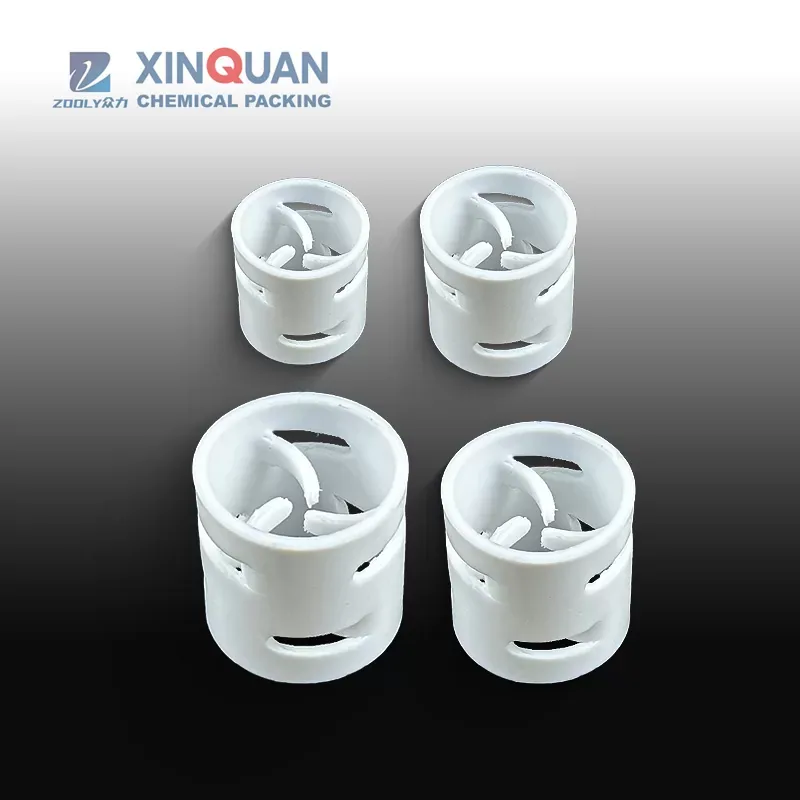
PTFE is what you specify when nothing else survives. A PTFE pall ring keeps the open, ribbed geometry of a metal or plastic pall ring while removing the two failure modes that decide column life in aggressive service: chemical attack, and metal ion leaching into the product. It is used where hydrofluoric acid, wet chlorine, bromine, hot concentrated sulphuric acid or strong alkali would destroy ceramic, PP or stainless within months.
Specifications
| Parameter | Value |
|---|
| Form | Ribbed pall ring with internal tongue, moulded |
| Material | Virgin PTFE; PTFE with graphite or glass on request |
| Nominal sizes | 25 mm, 38 mm, 50 mm |
| Service temperature | Up to about 250 C continuous, far beyond PP or PVDF |
| Chemical resistance | Inert to virtually all acids, bases, halogens and solvents |
| Mechanical note | Softer than ceramic or metal; bed depth has to be checked for creep load |
| Selection inputs | Column diameter, gas and liquid loads, temperature, trace contaminants |
Available Materials
Virgin PTFE · PTFE with graphite · PTFE with glass fibre on request
Typical Applications
- HF absorption and stripping
- Chlor-alkali and wet chlorine scrubbing
- Bromine and halogen handling
- Hot concentrated acid absorption
- High-purity duty where metal ions are not acceptable
- Solvent recovery where plastics swell
How It Compares
Against ceramic, PTFE removes the HF and hot-alkali attack problem and survives thermal shock, at a higher price per cubic metre and with lower mechanical stiffness, which matters when the bed is deep. Against PP and PVDF it extends the usable temperature range and covers oxidising acids that would embrittle either. Against metal it removes corrosion entirely, and with it the risk of iron or nickel contamination in the product.
Frequently Asked Questions
Why choose PTFE instead of ceramic for an acid tower?
Ceramic is cheaper and stiffer, but silica-based bodies are attacked by HF and by hot concentrated alkali, and thermal shock can crack them. PTFE is unaffected by either. If the tower handles HF, wet chlorine or hot caustic, PTFE is usually the only packing that survives a realistic campaign length.
What is the maximum service temperature?
About 250 C continuously for virgin PTFE, well above PP or PVDF. Above that, or where the bed load is very high, a metal or ceramic packing is the better choice: the limitation of PTFE in a deep bed is mechanical rather than chemical.
Can the packing be re-used after a shutdown?
Yes. It does not corrode or embrittle, so it can be washed, inspected and re-loaded, and it is often recovered and re-used when a column is re-packed with a different geometry.
Does the softness of PTFE cause problems?
It can creep under load. In deep beds we specify a properly designed support plate and, at larger diameters, a thicker wall; we check the load against your bed depth before quoting rather than after.
Related Products
Raschig ring in metal, plastic and ceramic. The classic random packing for simple, robust columns. Factory-dir…
Cascade Mini Ring (CMR) random packing for high-efficiency distillation and absorption. Lower height per theor…
IMTP-equivalent saddle packing for high-capacity distillation and absorption. Open, non-nesting geometry. Fact…
Get a quote for PTFE Pall Ring
Tell us your flow rate, medium and operating conditions — we recommend the right packing and internals, and quote factory-direct.
Request a Quote WhatsApp