Activated Alumina
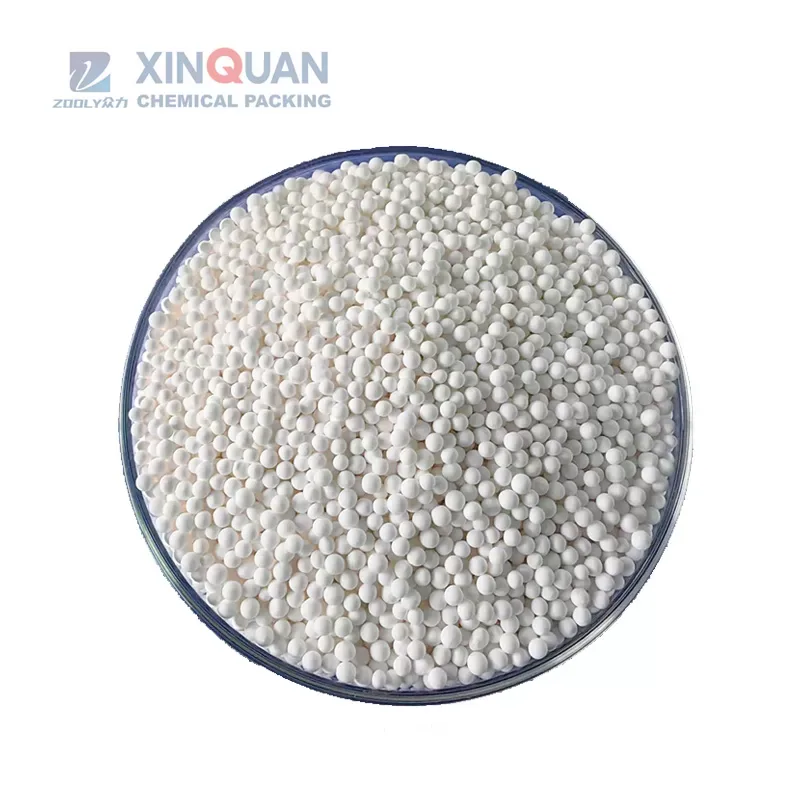
Activated alumina is the default desiccant in industrial gas treating, and it holds that position for practical reasons: it is mechanically strong enough to survive repeated regeneration, it does not break down into fines under thermal cycling, and it keeps working after being wetted. Its limitation is selectivity — it removes water well, and it removes other polar molecules too, which is either the point or a problem depending on the duty.
Specifications
| Parameter | Detail |
|---|
| Form | Spherical beads, high surface area, porous |
| Primary functions | Gas and liquid drying, fluoride removal, peroxide purification, catalyst support |
| Regeneration | Thermal regeneration with hot gas; cooling and repressurisation part of the cycle |
| Selectivity | Adsorbs polar molecules preferentially, water above all |
| Key selection inputs | Inlet water content, target dew point, cycle time, gas composition, allowable pressure drop |
| Related grades | Impregnated variants for chloride, mercury or specific contaminant duty on request |
Available Materials
Activated alumina (spherical) · Impregnated grades on request
Typical Applications
- Compressed air and instrument air drying
- Natural gas dehydration
- Fluoride removal from drinking and industrial water
- Hydrogen peroxide purification and regeneration
- Catalyst and catalyst support in Claus units
- Dechlorination and arsenic removal duty
How the Options Compare
Against silica gel, activated alumina tolerates liquid water contact better and holds up under more regeneration cycles, which is why it dominates compressed air and natural gas drying. Against molecular sieve it is cheaper and has higher water capacity in benign streams, but it does not give the sharp selectivity a sieve offers when CO2 or heavier components have to be excluded.
Frequently Asked Questions
When is activated alumina enough, and when do I need a molecular sieve?
If the target is only water removal in a stream where co-adsorption does not matter, alumina is usually the economical answer. If the same bed must also remove CO2, or if co-adsorbing other components would damage the product or the downstream unit, a sieve with the right pore opening is needed.
How is the bed regenerated?
Thermally, with a hot dry gas stream, followed by cooling before the bed returns to service. Cycle length and regeneration temperature are set by the water loading and the dew point required — we size the bed from those inputs.
Does the bed need a support layer underneath?
Yes, in most vessels a graded inert ball layer separates the adsorbent from the outlet collector, filters fines and prevents the beads from migrating into the outlet.
Can it remove fluoride from water?
Yes, that is one of its established uses — the alumina is regenerated with a caustic wash rather than by heating. Send the water analysis and flow rate for bed sizing.
More Adsorbents & Desiccants
3A molecular sieve (potassium form) for drying cracked gas, olefins and ethanol where CO2 and heavier componen…
4A molecular sieve (sodium form) for gas and liquid drying, CO2 and H2S removal, refrigerant drying and static…
5A molecular sieve (calcium form) for PSA oxygen generation, n-paraffin separation and combined drying with CO…
Ask about activated alumina
Tell us your flow rate, medium and operating conditions — we recommend the right packing and internals, and quote factory-direct.
Request a Quote WhatsApp