3A Molecular Sieve
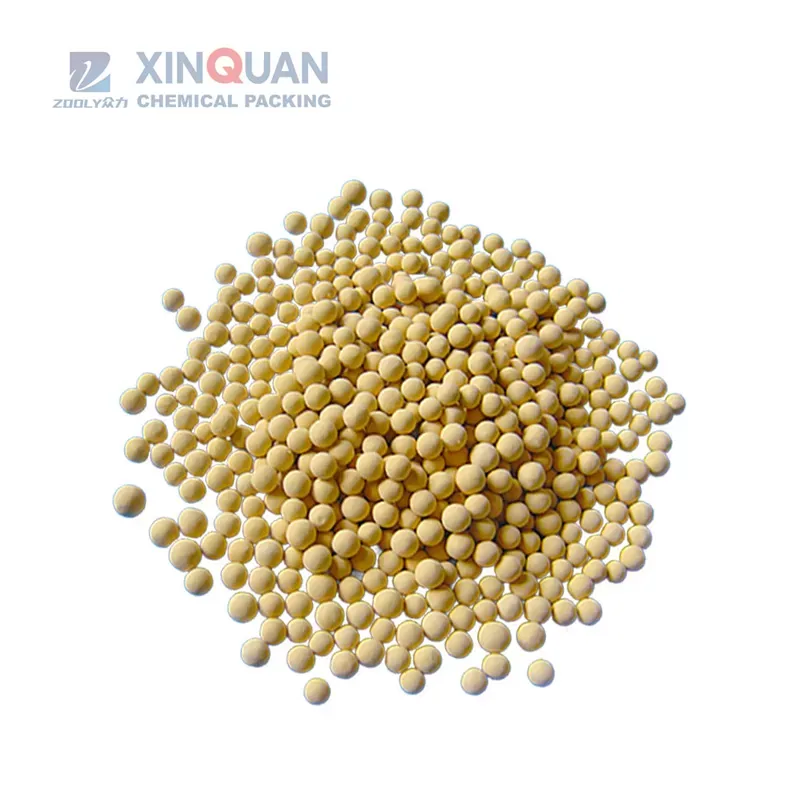
The 3A sieve is the drying option you choose when water is the only thing you are allowed to take out. Its pore opening admits water but excludes larger molecules, so CO2, H2S and heavier hydrocarbons pass through instead of being held on the bed. That makes it the standard choice for drying cracked gas, ethylene and ethanol streams where co-adsorption would cost you product or poison the bed.
Specifications
| Parameter | Detail |
|---|
| Type | Type A zeolite in the potassium form |
| Pore opening | Smallest of the common A-type sieves — water admitted, larger molecules excluded |
| Behaviour | Low co-adsorption of CO2 and heavier components compared with 4A and 13X |
| Regeneration | Thermal regeneration with hot dry gas, or pressure-swing where the duty allows |
| Key selection inputs | Inlet water, target dew point, stream composition, cycle time, allowable pressure drop |
| Form | Spherical beads and pellets |
Available Materials
Zeolite 3A (potassium form) · Binder-bound beads
Typical Applications
- Cracked gas and olefin drying
- Ethanol and solvent dehydration
- Natural gas drying where CO2 must not be co-adsorbed
- Insulating glass and refrigerant drying
- Drying of reactive streams sensitive to co-adsorption
How the Options Compare
Compared with 4A, the 3A sieve removes less from the stream — deliberately. Its value is selectivity: drying without stripping CO2 or recovering heavier molecules onto the bed. If your process actually wants simultaneous CO2 removal, 4A or 13X is the correct choice instead.
Frequently Asked Questions
Why choose 3A rather than 4A for drying?
Because 4A will also hold CO2 and other small molecules, which may be unacceptable in olefin or ethanol duty. 3A dries the stream while leaving those components in the gas.
Can it be regenerated in place?
Yes. Hot dry gas regeneration is standard, with cooling and repressurisation as part of the cycle. Bed design sets the cycle length.
Does it work in pressure-swing duty?
It can, where the water loading and cycle are compatible with PSA operation. Thermal regeneration remains more common for deep drying.
More Adsorbents & Desiccants
Activated alumina balls for gas and liquid drying, fluoride removal, hydrogen peroxide purification and Claus …
4A molecular sieve (sodium form) for gas and liquid drying, CO2 and H2S removal, refrigerant drying and static…
5A molecular sieve (calcium form) for PSA oxygen generation, n-paraffin separation and combined drying with CO…
Ask about molecular sieve 3a
Tell us your flow rate, medium and operating conditions — we recommend the right packing and internals, and quote factory-direct.
Request a Quote WhatsApp