RTO Honeycomb Ceramic Heat Exchange Media
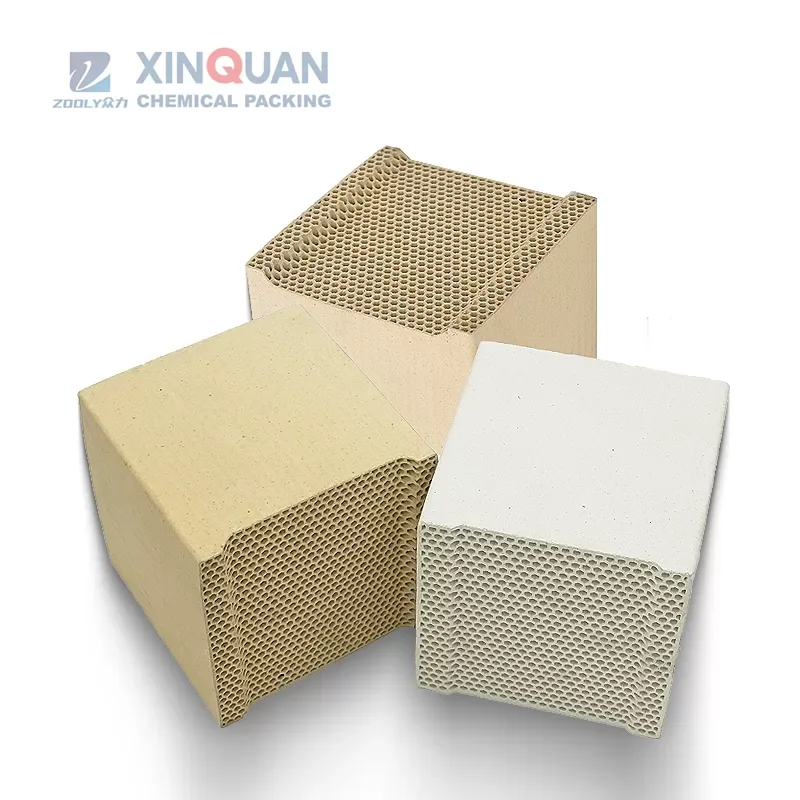
A regenerative thermal oxidiser works by storing heat in a ceramic bed on the way in and giving it back on the way out. The honeycomb geometry is what makes that practical: a straight-channel monolith gives a large surface area per cubic metre with a pressure drop that stays low even at high face velocity, and a cordierite or mullite body survives the rapid cycling that the switching valve imposes.
Specifications
| Parameter | Detail |
|---|
| Form | Straight-channel monolith blocks, stacked into the bed |
| Material | Cordierite and mullite; high-alumina grades for hotter duty |
| Channel density | Selected against pressure drop and fouling risk rather than picked at random |
| Thermal behaviour | Resists the cycling produced by valve switching |
| Installation | Stacked with a suitable support and sealing arrangement to stop bypass |
| Selection inputs | Gas flow, VOC loading, cycle time, allowable pressure drop, operating temperature |
Available Materials
Cordierite · Mullite · High alumina
Typical Applications
- Regenerative thermal oxidisers
- VOC and odour abatement
- Heat recovery from hot exhaust gas
- Catalytic oxidiser support media
How the Options Compare
Against ceramic random packing or saddles, honeycomb gives a much lower pressure drop for the same heat transfer duty, and pressure drop is the main operating cost of an RTO because it sets fan power. Against metal structured media, ceramic takes higher temperatures and does not oxidise. The trade-off is fouling: a straight-channel monolith blinds if the gas carries particulate or sticky condensate, so the duty has to be clean.
Frequently Asked Questions
Why honeycomb instead of ceramic saddles in an RTO?
Pressure drop. A straight channel passes gas with far less resistance than a dumped bed for the same heat transfer area, and in an RTO that difference shows up directly in electricity consumption every hour the unit runs.
What blinds a honeycomb bed?
Particulate, sticky condensate and carry-over from the process. Because the channels are straight and small, anything that deposits on the wall stays there. If the exhaust carries dust or tarry material, the design needs a filter or a different media in the first layer.
Which material should I choose?
Cordierite covers most RTO duty with good thermal shock resistance at reasonable cost. Where peak temperature or cycling is more severe, mullite or a high-alumina body is the safer choice.
Can the blocks be replaced individually?
Yes. The bed is stacked from separate blocks, so damaged or fouled sections can be lifted out and replaced without renewing the whole bed, which is one reason the format is used rather than a monolithic structure.
More Honeycomb Ceramics
Cordierite wall-flow honeycomb substrates for diesel particulate filters. High filtration efficiency, low back…
Ask about rto honeycomb heat exchange media
Tell us your flow rate, medium and operating conditions — we recommend the right packing and internals, and quote factory-direct.
Request a Quote WhatsApp