13X Molecular Sieve
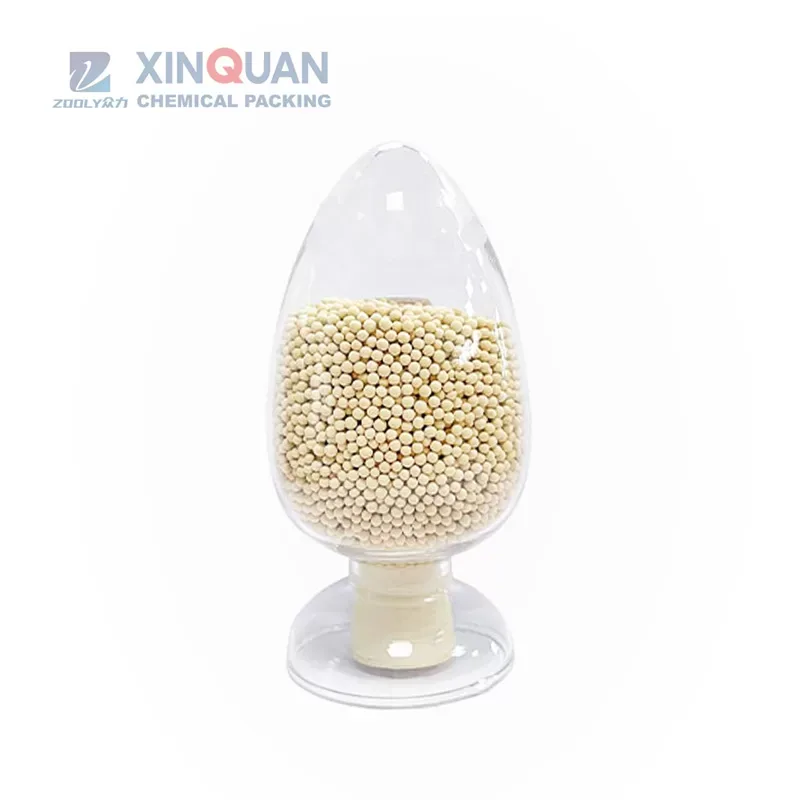
The 13X sieve has the widest pore of the common grades, which gives it capacity for molecules the A-types cannot hold: mercaptans, THT, heavier hydrocarbons and bulk CO2. It is the standard media for air prepurification ahead of cryogenic separation, and for gas treating where the contaminant is bigger than water.
Specifications
| Parameter | Detail |
|---|
| Type | Sodium form type X zeolite |
| Pore opening | Widest of the common grades — takes in bulky molecules as well as water |
| Distinguishing behaviour | Higher capacity for CO2, mercaptans and heavier species than 4A or 5A |
| Regeneration | Thermal regeneration; pressure swing in prepurification duty |
| Key selection inputs | Contaminant type and loading, CO2 and water content, cycle, purity target |
| Form | Spherical beads |
| Variant | Low-silica and high-capacity grades available on request |
Available Materials
Zeolite 13X (sodium X) · Binder-bound beads
Typical Applications
- Air prepurification before cryogenic air separation
- Bulk CO2 and water removal from natural gas
- Mercaptan and odourant removal from gas streams
- Hydrogen and syngas purification
- Drying of streams containing heavier hydrocarbons
- Guard beds ahead of cryogenic exchangers
How the Options Compare
Compared with 4A, 13X holds larger molecules and more CO2 per unit of bed, at a higher cost. Its advantage disappears in clean light-gas drying, where 4A does the job for less; it earns its cost where mercaptans, bulk CO2 or heavy ends have to come out.
Frequently Asked Questions
Why is 13X used in air prepurification?
Because it removes both water and CO2 down to the levels a cryogenic exchanger needs, and it tolerates the cyclic pressure-swing duty those units run. Residual CO2 freezing in the cold box is the failure it prevents.
Can it remove odourant from natural gas?
Yes — 13X is used for THT and mercaptan removal where the gas has to be odour-free downstream. Loading and cycle design come from the sulphur content of the feed.
How does it compare on cost?
It is the more expensive of the common grades, so it is specified where its capacity for larger molecules is actually needed rather than as a general-purpose desiccant.
More Adsorbents & Desiccants
Activated alumina balls for gas and liquid drying, fluoride removal, hydrogen peroxide purification and Claus …
3A molecular sieve (potassium form) for drying cracked gas, olefins and ethanol where CO2 and heavier componen…
4A molecular sieve (sodium form) for gas and liquid drying, CO2 and H2S removal, refrigerant drying and static…
Ask about molecular sieve 13x
Tell us your flow rate, medium and operating conditions — we recommend the right packing and internals, and quote factory-direct.
Request a Quote WhatsApp